At risk of offending right-wing snowflakes,
The BumblePuppy Press alters a classic
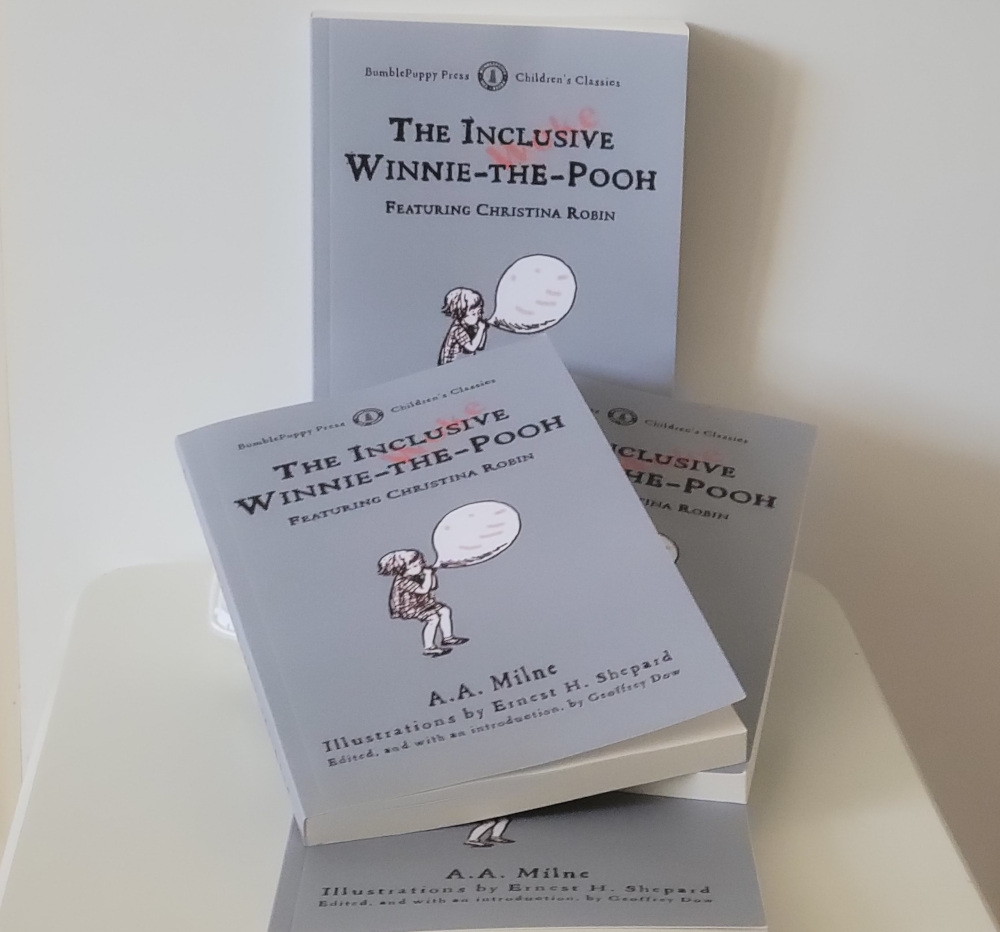
December 2, 2025, Ottawa — When I was nine or 10, I was given a copy of an edited version of Robinson Crusoe for Christmas. By “edited,” I mean it was cut, bowdlerized, not the full text.
Even then, I wanted the real thing — not what some editor thought I should read, but what the author wrote.
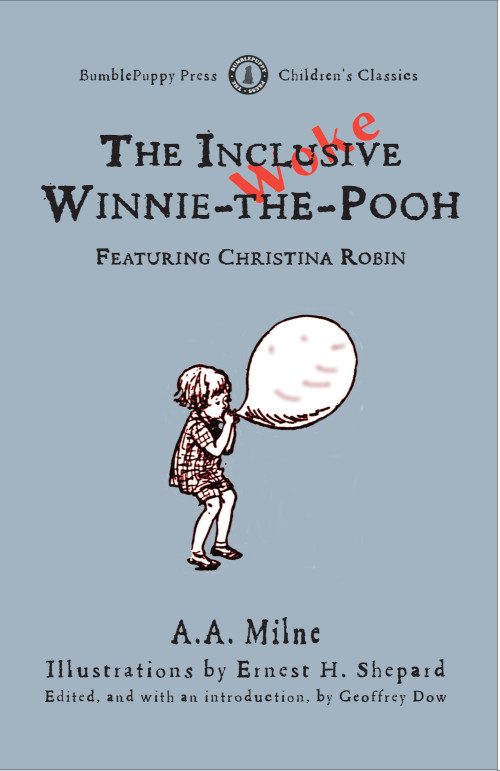
How then did a literary purist such as myself put his name on the cover of this altered version of Winnie-the-Pooh? How did I come to make Christina Robin out of Christopher?
For one thing, I am father to Baobao, my now six year-old daughter. And it didn’t take me long to realize that all too many children’s books — especially, but definitely not limited to, older classics — feature casts that are entirely male, unless the story features a mother-figure (hi, Kanga!).
Though I am a man, I am all-too aware of the unfair truth: that male remains the default state in our world, more than 50 years since the advent of “women’s lib,” or what is now called second-wave feminism. Yes, things have improved; women, members of the LGBTQ+ communities, and people of colour, are more visible in many aspects of life, but still, being a girl is far too often treated as a special case. (And yes, there is one hell of a push-back happening in many parts of the western world right now.)
Here is a sampling of the books I read to Baobao when she was young, and which helped to inspire this adaptation.
• I Can Read About Whales and Dolphins (1996): Though animals are often referred to as it, and the gender-neutral they goes back at least as far as Shakespeare, in this book every animal is a he (unless — sigh — that animal is a mother);
• Grasshopper on the Road (1978): A grasshopper sets out on a long walk and meets many other insects along the way. The titular character is male, as are all of those he encounters (with the possible exceptions of three butterflies, and two dragonflies, which are always referred to as plural they);
• Le castor qui travaillait trot fort (2011): A beaver (male) works too hard, bothering his friends, a moose (male) and a bear (male);
• Many (though not all) of Dr. Seuss’ otherwise wonderful stories; and, of course,
• Pooh itself. Every animal but Kanga, a mother, is male, as is the only human character.
It’s not just unfair that this still goes on, it’s absurd. Like adults, small children are (at least) boys and girls, and there is no good reason that so many books still refuse to reflect this basic fact.
If this absurdity is tiresome to me as a straight, cisgender man (and it is!), how much more tiresome must it be for girls and women?
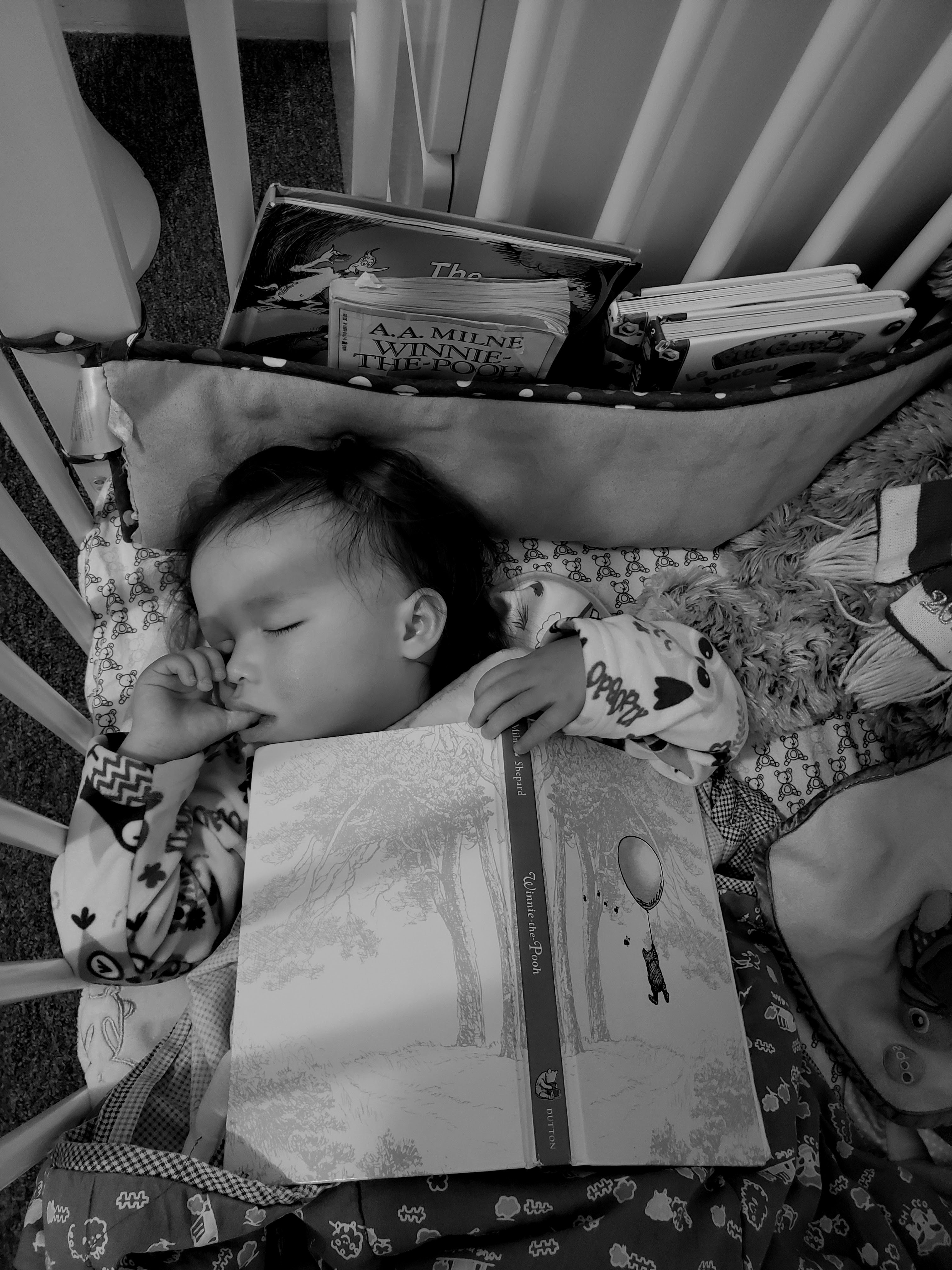
So, when Baobao was two years old and was developing the patience for longer stories, I decided to do something about it. Rhythmically, Christina Robin worked just as well at Christopher, so why not, I asked myself, switch it up? Since that worked, why not also make Piglet she instead of he? And why not Eeyore as well?
(Actually, Eeyore was a late change. When Baobao became obsessed with Pooh, one of her refrains was, “Rabbit is funny! Owl is funny! Eeyore is funny!” I realized that my version left all the best comedic bits to the boys, and so, Eeyore made the transition from male to female and, when Tigger made their appearance, it was easy enough to read them as non-binary.)
Are these changes A.A. Milne would have approved of? Quite possible not. He was, after all, already an adult when Queen Victoria died.
But on the other hand, he was a man who really got children, as the stories in this book serve to show very clearly. (And check out his poem, “Busy,” from Now We Are Six — also forthcoming from the BumblePuppy Press, if this book sells at all well) — for one of o! so many wonderful examples.)
Maybe, had Milne lived to see the changes that have marked our own era, he would have said, Yes, let’s make these stories more inclusive! It’s pretty to think so, anyway.
Now, maybe you mind the idea of making such changes to a classic. Maybe you agree with my 10 year-old self that an author’s work should be sacrosanct.
Well, I have good news for you. The existence of The Inclusive Winnie-the-Pooh does not erase the original. In fact, and like colourised movies, the original is available in just about every bookstore in the English-speaking world, in any number of editions, from the fanciest of boxed sets, to editions published on the coarsest pulp paper.
So, if you are a purist, don’t buy The Inclusive Winnie-the-Pooh; the original is out there and always will be.
But for me? I want my daughter to have a copy of the book she heard me read to her when she was very young.
The stories remain the same, but I hope I have opened doors for other players to take up the parts.
NOTE: Due to copyright issues, this book is currently available for sale only in Canada and the United States of America. The book is available from the Big A, and (my preference) direct from the publisher via https://www.bppress.ca/shop. An un-encrypted (DRM-free) ebook will be available soon.