
An elegy
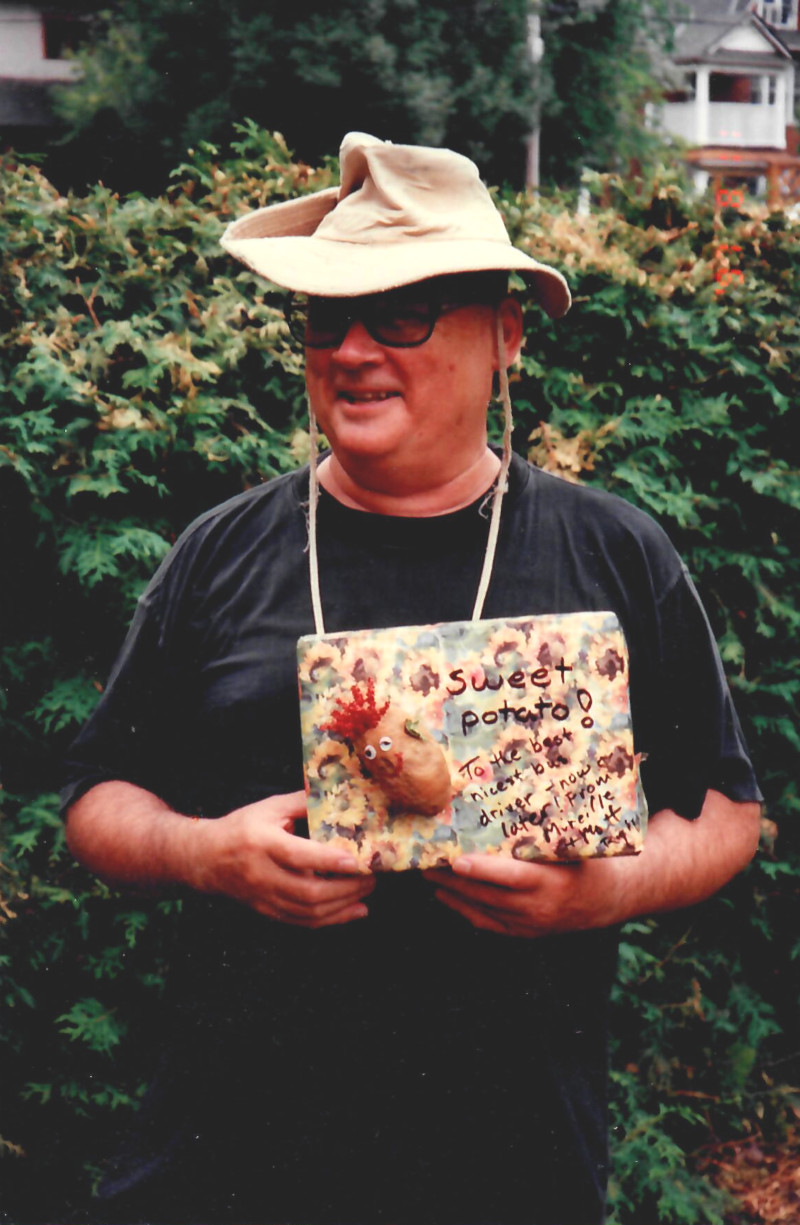
By Geoffrey Dow
August 24, 2026, OTTAWA — When I was a boy, I remember one hilarious night when I was no more than 10 years old, and probably younger. My maternal grandfather, Bill Hart, had died not too long before, and death was on our minds (my father, my mother, and my younger brother).
Somehow, the topic of my father’s death arose, and he declared that he wanted nothing more than to be tumbled into a potato sack and left out with the next week’s garbage. That idea – “Potato Bag Pa” – seemed absolutely hilarious to all of us.
50 or so years later, when Carl (my dad) was looking forward to his 93rd birthday, death came up again on one of our regular Saturday night get-togethers.
“I don’t want a funeral,” he told me. “Or a wake.”
“What about your body?” I asked. “Cremation? Burial?”
“Who cares, I won’t be there!”
A little to my surprise, I discovered that I cared. And so I made arrangements to scatter his ashes around the base of a tree my friend has named the Grandparent Tree. Carl died on May 20th, 2026; we scattered his ashes on August 9, 2026.
And it turned out I had more to say than I had expected. For those who don’t want to listen to me for 14 minutes and 53 seconds, the script (as I wrote it; I know I deviated from it a little) is below the video.
• • •
- For a man who loved life, did not fear death, but who still hoped to leave a lasting legacy, he would certainly have liked to know his books were read after he passed on. They are, of course, available through this website. Barring that, he would not have objected to a donation being made in his name (or not) to the Communist Party of Canada;
- If I’m being fully honest, I kind of wish I had worn long pants for this, but my daughter and I were on the eighth day of a tenting trip; casual was practically in our genes at that point; and,
- Finally, a note to those of you who knew him, or who read his books. Please feel free to leave a memory in the comment section below.
Video of the elegy and scattering:
The transcript
August 9, 2026, Papineau-Cameron District, Ontario — So, the time has come: Carl Edward Dow, nee Drozdowicz, has shuffled off this mortal coil, he would have said, before his time. Late in his 93rd year, he died at the Ottawa Hospital, awaiting surgery for an infection on one of his too-often operated hips.
Half an hour before he was found dead, he was heard laughing and talking with others in his room by the nurse I spoke with. I take comfort in knowing that he died as he mostly lived: voluble, in happy spirits, and with plans for the future. As he said to me the last time we socialized, about a week before, “I still have a lot of work to do.”
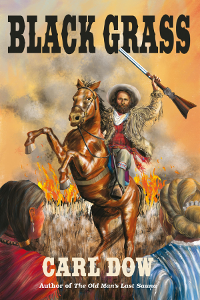
He was almost finished his new novel, Wildflowers, and told me that he had started work on a new one, a sequel to his historical romance, Black Grass, a book that he said would offer new insights into the perfidy (not that he would likely have used that word) with which John A. MacDonald lured the Metis into a war with Canada that they could not win.
After that, he planned to write a memoir, work he hoped would take him to the century mark, after which he felt he would be ready to let go of life, which he loved so much, despite the many physical – and psychological – pains that life had inflicted upon him.
Most of that is now moot; as his publisher, I hope that Wildflowers is finished enough – he had been saying it was “almost” done for literally years – but the sequel and memoir will forever be volumes limited to the un-written books located in Morpheus’ unreachable library.
• • •
I said that Carl (I called him “Dad” but have referred to him as “Carl” for many years now) was a man of great humour. He was also a man of great appetites. In his earlier years, he was, as he liked to say, a man who drank to get drunk and ate to get full.
Before the end, the drinking stopped, and even his appetite for food had diminished. He had lost half of his teeth – I’m sorry if that seems like too much information, but neither I, nor Carl, thought that death should turn biography into hagiography – and even his enjoyment of foods he could gum as well as chew had greatly diminished towards the end. I was sad that he did not even much enjoy sweet and sour sauce anymore, though he did still manage to take pleasure in drinking (yes, drinking) several pints of Ben and Jerry’s vanilla ice cream every week.
• • •
Like most of us, Carl was a man of contradictions. He was swift to anger (we had a fight, ostensibly about politics, that saw him tell me to “fuck off”, only a few months before he died), but equally quick to apologize – *if* he thought he was in the wrong.
He was fiercely loyal to friends and family, as quick to forgive as he was to apologize, but he could also also be an implacable enemy if he believed you were not coming from a place of fundamental goodwill.
Despite his loyalty, he was regretfully estranged from some members of his family, and at war with a few.
On the other hand, he was a man who could be a rock in times of crisis. His great friend Randy, and his partner Frances, both can and do attest to that.
• • •
Besides fiction, his other passion was politics.
He was (as many among the current powers-that-be put it these days) “radicalized” when he was in his early teens. As I remember the story – I will forever miss that un-written memoir – he participated in a youth-led demonstration, then read an article about it in the *Ottawa Citizen*. An article that was about as full of lies as it could possibly have been. That led to him to the realization that those in power do not serve the interests of the people, but only of themselves.
Nevertheless, he ended up in journalism himself, working for papers as mainstream as The Montreal Star and The Globe and Mail, among many others. He also, during the 1960s and early 1970s, wrote for magazines like Weekend, and The Canadian. One editor told Carl that he was one of the top ten writers in the country.
But he also had trouble with deadlines. He received more than one Canada Council grant to write a biography of Brock Chisholm in the late 60s or early 70s, and – as I learned when I was doing my best to organize his papers as I was cleaning out his apartment – he was still telling people that it would be finished “soon” in the late 1980s.
It remains unfinished, and I am not sure when – or even if – he ever admited to himself that it never would be.
Even while still working in journalism and freelance writing in the 1960s, he got involved in electoral politics, organizing campaigns for the NDP in Montreal. And in the early 1970s, he moved his family to the outskirts of Sudbury, where he built a house on a piece of my mother’s ancestral land, where he and my mother launched True North, a labour-oriented newspaper, on a wing and a prayer (and a bank loan or two). That was a publication quite popular with readers, but not so much with advertisers.
The paper survived my parents’ separation and subsequent divorce by a few years, and was revived as an online newsletter in the 21st century, even as he returned some of his attention to writing fiction.
He also returned wrote for the Ottawa Citizen in those days, writing advertorials. On a higher note, he took over as editor of the slick magazine Humanist Perspectives for a few years, ending around 2010.
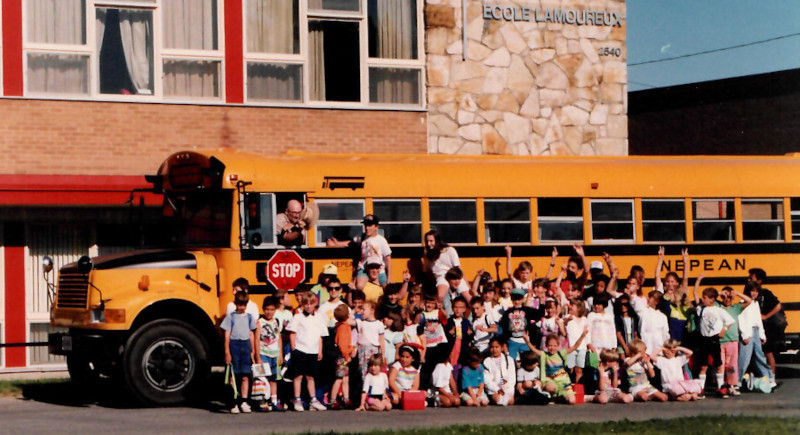
And he worked his happiest job late in life, driving school bus in Ottawa for nearly a decade (during which time, naturally, he got involved with the drivers’ union and edited its newsletter). But he loved dealing with the kids, and they loved him, as a big collection of cards and drawings serve to prove.
• • •
All of which, I fear as I type, seems pretty like pretty thin soup.
Carl, my father, was a weird man in general, and a remarkable father – in good ways and bad. (I say that last as a man who is now a father myself.)
As a 3 year-old, we lived in the country north of Montreal, outside of a town called St-Donat.
From there comes one of my first memories. I was taking a walk in the bush, with only my dog, Dog (I had named him), as a companion. At some point, I realized that I had no idea where I was. Lost in the woods at 3 years old! But Dog seemed to understand when I told him, and he led me home, both safe and un-traumatized.
Would I have let my own daughter do the same at that age? Not on your fucking life! (My folks also let me play by myself and Dog the side of the river across the road; and Carl let me steer his car, at the same time, then drive it, as soon as I could reach the pedals. I was 12 when I first took the wheel on the 401. Memory says that Carl napped in the back seat. Craziness? Probably.)
• • •
Christ, how do you do justice to a life in a few minutes?
I’ve said Carl had a great sense of humour, but have given no examples. How about something scatalogical?
Some years ago, he visited his partner Frances in Toronto. As can happen to those who seldom eat their vegetables, he got constipated, so badly that Frances insisted he go to Emergency.
Once there, the M-deities worked their magic – a little too well.
All of a sudden what hadn’t been moving at all, was bursting forth like Katyusha rockets and he was being wheeled out of the waiting room at top speed as a week’s worth of excrement spewed out behind him.
“I hope everybody paid for their tickets!” Carl called out as he passed through.
• • •
Is that a terrible way to end this?
I hope not. Carl believed that human beings are, and are only, animals, differing only in sophistication from the ant or the raven.
As a child, he explored religion – at one point, he and his sisters would visit different churches every Sunday – but (he told me) it didn’t take him long to decide that *all* of them were nonsensical.
He was, still, respectful of the beliefs of others, provided they did not try to push their beliefs on him.
One day, he was awoken far too early by a knock on the door. When he opened it and found a pair of Jehovah’s Witnesses asking if he believed in Christ the Saviour, his answer was short, but not quite sweet.
“I could no more believe in your god than I could believe in Santa Claus,” he said before closing the door on them.
He loved life but he did not fear death; he had no existential angst, but just accepted that our time is but a brief dance across an a stage whose tale started long before we came into existence, and will continue long after we are gone.
If we have any purpose, he might have said, it is enjoy what we can, and – with hope – strive to leave the world a better place than it was when we entered it.
Hope was one of Carl’s greatest strengths; it carried him get through many hard times with laughter, but it was also one of his weaknesses.
His mind was intensely political, but when it came to analyzing the state of the country, and the world – something he could not help doing pretty much until the day he died – he sometimes expected too much decency and good sense from others.
I remember asking him, back in February of 2022, what he thought of all the talk going on about a possible Russian invasion of Ukraine.
He scoffed, saying there would be no war. It was only a day or two later that Russia did in fact launch its Special Operation.
And, going through his papers, I came across an op-ed he’d written, and tried to sell, the thesis of which was that there would be no American invasion of Iraq – an essay sent out not long before that invasion happened in 2003.
Similarly, he believed for a long time in Donald Trump’s promise to be a President for peace. Only this year’s attack on Iran finally convinced him that he had been wrong – and when he was convinced, he admitted that he had been wrong without any attempt to equivocate.
Still, he was right more often than he was wrong, as the fact that Canada remains one country attests to.
• • •
I am kind of at a loss as to what else to say. A life as rich as Carl’s was, a life of deep friendships and love affairs, of victories and defeats, of political persecution (see Len Scher’s book, The Un-Canadians for details about a decades’ long campaign of psychological harassment conducted against him by Canada’s various “intelligence” and “security” agencies over decades for some of the details), frankly needs at least a novella-length essay (ahem. Yes, I’m working on one) to do it justice.
I’ll stop now. Here we are. One son, one grand-daughter, and two of my best friends, one of whom knew Carl and with whom the other only *might* have had a glancing acquaintance. To scatter his ashes on ground that he never visited, let alone lived.
If that sounds sad, consider that he lived nearly 93 years. Over the last few years, during our regular Saturday night get-togethers, he would sometimes thinking of an old friend and wonder how they were getting along. I would whip out my friend and ask, “Should I try to find out?”
More often that not (when I could find them), they were dead, often long dead (journalists both drank and smoked far too much in the 50s, and 60s, and 70s). Of those that remain, most are too far away to make the trip.
And he told me he wanted no funeral, no wake, nor even a celebration of life.
So here we are, just the 4 of us; 3 of them indulging me in then sort of talk usually meant for a crowded room.
Goodbye Carl, dad. I’ll miss you.
And speaking of indulgence I’m going to close with a song, adapted from one Carl sang when the aforementioned Dog – a noble animal indeed – left us far too soon when I was 8. (If ever this goes online, I hope the rights-holders to the original will show mercy, and not sue me.)
Old dad is dead,
Old grandpa’s really dead.
Carl’s dead and he ain’t coming back
(Coming back)!
Old grandpa’s really dead,
Old Carl’s really dead,
He’s dead and gone and
He ain’t coming back.
Let the scattering begin.
This one is for Vivian and Walt, and family; this for Frances; this for Loraine and Marian; this for Randy Ray, and this for Faduma. This in memory of Lillian and Marcel, and for their family; this in memory of Steve and Lena; and this one for all those whom time and memory have left un-named.
Goodbye dad.

Thank you Geoff for this wonderfully thoughtful eulogy in honour of your larger-than-life father- Carl. I learned so much about him (and you) from reading this and wished I had met him in person- during his lifetime.
May his memory be forever a blessing.
*Interestingly, the Ukraine-Belarus is also where my paternal lineage originated- though my grandmother identified as a Russian Jew.
Thank you, Suzanne. Had you two met, I think you would have liked each other.
One of my favourite uncles was a Polish Jew by way of Belgium, who came to Canada as a refuge after WWII, but he married into the family.
You knew your dad well, and now the rest of us know something of him, and your relationship with him.
Such a great send off for Carl.
R.I.P.
Thanks, Sally, I appreciate those words; as usual, I wasn’t too sure of mine at first.
I met Carl 10 years ago and I always loved listening to his stories. When Randy Ray and I visited Carl in his apartment I was always trying to tidy up his table of papers, pill bottles and napkins. He would give me permission to get rid of a few things but he liked everything left just the way it was. One time he asked me to look for his nail clippers. I not only found them but also a pair of reading glasses he had lost a week ago. We had a good laugh over the result! Carl had many people helping him so that he could stay in his apartment. Because of his likeable personality, funny stories, quirky anecdotes and inspiring questions, I always returned to share a cup of tea with Carl and deliver his Harveys burger.
Carl Dow lived an incredible life and he leaves his friends and family with so many memories.
He was loved and will be missed.❤️
He considered you a good friend, Judy, and was always happy to report on your visits!
Carl was a special and unique person, and the former members of my Advertising Features department remember his cheerful personality and sense of fun as he submitted his wide ranging freelance articles.
Memorably, he promised me a ride on his motorcycle to Manotick after I completed my first marathon in 1999, and it remains my ONLY ever motorcycle ride. My sympathy to you and your family.
Thanks for that, Louise. My dad spoke of you with affection.
This may have been one of the highlights of Carl’s life, certainly one that he got huge enjoyment out of:
He hated John Bassett, publisher of the Toronto Telegram, with a passion. Carl was the paper’s Montreal correspondent, during the Expo summer. Finally, he could take it no longer, and quit. And what do you know? His termination didn’t go through the paper’s bureaucracy, and his pay cheques kept coming! I’m not sure how long they kept arriving, but when the Tely finally twigged, they demanded the money back. Carl had checked with a lawyer, and didn’t repay a cent. But he felt that was the best revenge on the loathsome John Bassett he could have had. Bassett paying him for not working at the Telegram!
RIP, Carl, for better or for worse, you were one of a kind.
Nice elegy, Geoffrey.
I remember that story. At least, if I’m thinking of the same story, Bassett was told that Carl was a Communist, to which he declared, “I’ll have no communists working for me!” and fired him. I think he told me the cheques kept coming for about six months.
Thanks Geoffrey for the lovely tribute to your dad. I met Carl through my friend Frances. Whenever I had to stay over in Ottawa, I slept on his fold down couch. We enjoyed BBQ chicken from Loblaws, great conversations, and a few laughs.
Elizabeth Hill, Toronto
Thanks for that, Liz. I think we met, once and only briefly, at his place when you were visiting.
Dear Geoffrey,
I have been in China (and still am) and unable to open my various app based communication systems on my mobile. But today, changed the sim card and discovered your beautiful tribute to your Dad, Carl.
I grew up with Carl in my life. And the stories abound. I will not wax eloquent now, but only to say that, I alway credit Carl with giving very best parental advice, when he came to visit Nick and me soon after the birth of our first born (Gabriel). It was simple and simply put: “Always let him know you love him.”
We will be in Ottawa some time in November and will hopefully be able to arrange to see you.
It was moving to see you and your young daughter in your elegy video.
All the very best,
Marion
Dear Marion,
That you so much for sharing some of your memories! I would love to see you in November and will send you my phone number via email.